Pearson Edexcel · A-Level · Economics B
Course version: 9EB0 · Version from Sept 2015
Business survival and cash flow: a) Distinction between profit and cash flow
Full specification wording
Business survival and cash flow: a) Distinction between profit and cash flow
Profit and cash flow are distinct financial concepts measuring different aspects of business performance.
Checked against the Pearson Edexcel 9EB0 specification (opens in a new tab) on .
- Point 1 of 4
- 4 key terms
Study notes
From the checked teaching notes for this specification point.
The idea
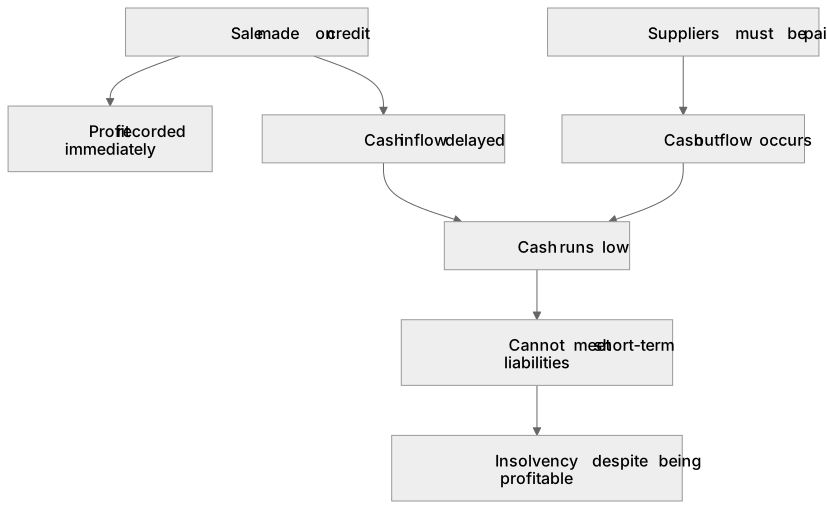
Profit and cash flow are distinct financial concepts measuring different aspects of business performance. Profit is calculated as total revenue minus total costs over a given period, recorded when a sale is made regardless of whether money has been received. Cash flow is the physical movement of money into and out of a business. A profitable firm can still fail if it suffers from poor cash flow, leading to insolvency. For example, if a business sells goods on credit, it records a profit immediately, but the cash inflow is delayed. If the business must pay its suppliers before customers pay their invoices, it may run out of cash to meet short-term liabilities, despite being profitable on paper.
What earns the marks
- Profit is the surplus remaining after total costs are deducted from total revenue.
- Cash flow represents the actual timing of cash inflows and outflows.
- A business can be profitable but experience negative cash flow if customers delay payment (trade receivables).
- A business can have positive cash flow but be making a loss, for example, by selling off assets or taking out a loan.
- Survival in the short term depends on positive cash flow to pay immediate liabilities, whereas long-term survival requires profitability.
Common mistakes and how to put them right
Using the terms profit and cash flow interchangeably.
Put it right: Profit is a measure of financial performance over time, while cash flow measures liquidity.
Assuming a profitable business cannot go bankrupt.
Put it right: A profitable business can fail if it lacks the cash to pay its immediate debts (insolvency).
Believing that a bank loan increases profit.
Put it right: A bank loan improves cash flow but does not increase profit, as it is not revenue and incurs interest costs.
Exam tips
- Use a clear example, such as selling on credit, to illustrate the timing difference between profit and cash flow.
- Emphasise that cash is required for day-to-day survival, making cash flow crucial for short-term business viability.
- When analysing business failure, distinguish between insolvency (lack of cash) and unprofitability.
Try the lesson
The start of the Business survival and cash flow: a) Distinction between profit and cash flow lesson, made from checked teaching notes for this specification point.
Have a go first
Which of the following best describes the fundamental distinction between a firm's profit and its cash flow?
Listen
Profit and cash flow are distinct financial concepts measuring different aspects of business performance. Profit is calculated as total revenue minus total costs over a given period, recorded when a sale is made regardless of whether money has been received. Cash flow is the physical movement of money into and out of a business. A profitable firm can still fail if it suffers from poor cash flow, leading to insolvency. For example, if a business sells goods on credit, it records a profit immediately, but the cash inflow is delayed. If the business must pay its suppliers before customers pay their invoices, it may run out of cash to meet short-term liabilities, despite being profitable on paper. A strong answer earns marks for these points. Profit is the surplus remaining after total costs are deducted from total revenue. Cash flow represents the actual timing of cash inflows and outflows. A business can be profitable but experience negative cash flow if customers delay payment (trade receivables). A business can have positive cash flow but be making a loss, for example, by selling off assets or taking out a loan. A common slip: Using the terms profit and cash flow interchangeably. Instead, profit is a measure of financial performance over time, while cash flow measures liquidity. Exam tip: Use a clear example, such as selling on credit, to illustrate the timing difference between profit and cash flow.
See it
Key words
Say what each word means before you turn the card.
Profit
Try answering aloud or in your head before turning the card.
Cash flow
Try answering aloud or in your head before turning the card.
Insolvency
Try answering aloud or in your head before turning the card.
Business survival
Try answering aloud or in your head before turning the card.
See every definition
- Profit
- The surplus remaining after total costs are deducted from total revenue over a given period, recorded when a sale is made regardless of whether money has been received.
- Cash flow
- The physical movement of money into and out of a business, representing the actual timing of cash inflows and outflows.
- Insolvency
- A lack of cash to pay immediate debts, which can cause a profitable business to fail.
- Business survival
- Short-term survival depends on positive cash flow to pay immediate liabilities, whereas long-term survival requires profitability.
Label the diagram
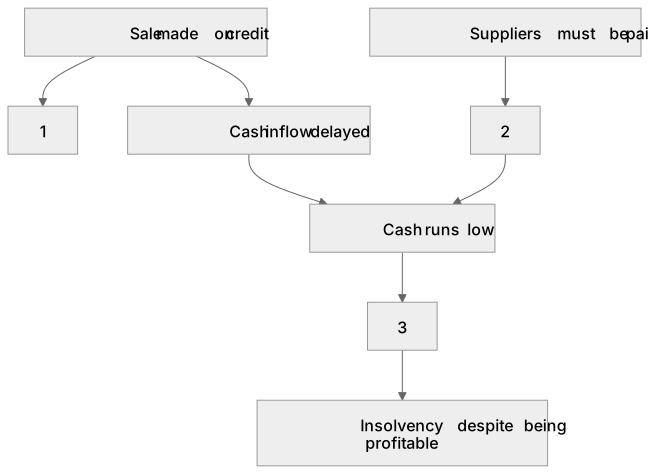
Some boxes have lost their names. Pick the right name for each number.
1Box 1
2Box 2
3Box 3
There is more to this lesson
The full lesson goes on to check your understanding and help you earn the marks. Create a free account to carry on, with your progress saved.
A week of Premium from your first lesson · Then the free plan continues · No card, no charge
Test your understanding of Business survival and cash flow: a) Distinction between profit and cash flow
Active recall beats re-reading. Take an instant quiz now to test what you’ve learned and lock it into long-term memory.
A week of Premium from your first lesson · Then the free plan continues · No card, no charge